
-1024x576.jpg)
Heat Guns
You can use a heat gun to bend polycarbonate sheets. Heat guns work well for small parts and thin sheets. You hold the gun close to the bend line and move it slowly. This heats the plastic and makes it flexible. You may need a wooden mold to help shape the bend. Heat guns cost less than other tools and are easy to use. They work best for simple bends and quick jobs. If you want to bend polycarbonate to a 90-degree angle, a heat gun can help. You should know that heat guns do not give high accuracy. They suit small projects and thin sheets.
| Bending Method | Advantage | Disadvantage |
|---|---|---|
| By heat gun | Easy to work, cheap, good for small parts, easy to bend 90 degrees | Low accuracy, low efficiency, may need a wooden mold |
Convection Ovens
Convection ovens help you bend polycarbonate sheets by heating them evenly. You place the sheet inside the oven and set the temperature. The oven warms the whole sheet, making it soft and easy to shape. Convection ovens work best for thicker sheets and complex shapes. You can use them for both small and large projects. The right temperature is important. If you set the oven too high, the sheet may warp or become hard to handle.
| Temperature Range | Description |
|---|---|
| 300°F – 500°F | Ideal temperatures for thermoforming polycarbonate, with flexibility increasing at higher temperatures. |
| 215°F – 450°F | Operational temperature range; exceeding this can make the material difficult to use. |
| 350°F – 375°F | Recommended heating range for shaping polycarbonate into complex forms. |
You should use convection ovens for Bending Polycarbonate when you need smooth curves or want to shape thick sheets.
Bending Benches
Bending benches give you a straight line to bend polycarbonate sheets. You place the sheet on the bench and heat the bend line. The bench keeps the rest of the sheet flat. This helps you make precise bends and reduces the risk of warping. Bending benches work well for making many pieces that need to look the same. You can use them for medium to thick sheets.
| Advantage of Bending Benches | Description |
|---|---|
| Creates a straight line to bend | This ensures precision in bending, which is crucial for producing multiple pieces efficiently. |
| Keeps the rest flat | This feature allows for uniformity in the bending process, reducing the risk of warping. |
If you want to bend polycarbonate for signs or covers, a bending bench helps you get clean, straight results.
Bending Machines
Bending machines use advanced technology to bend polycarbonate sheets with high accuracy. You set the machine to the angle and length you need. The machine heats and bends the sheet quickly. Bending machines work best for large projects and thick sheets. They help you make many pieces with the same shape. You waste less material because the machine bends each sheet the same way. This saves money and helps the environment. Bending machines also reduce mistakes and improve quality. You should use a bending machine for Bending Polycarbonate when you need tight tolerances and exact shapes.
Modern bending machines give you consistent results. You spend less time checking for errors and reworking pieces. This makes your project faster and more efficient.
Carbide-Tipped Tools
Carbide-tipped tools help you cut and trim polycarbonate sheets before and after bending. These tools stay sharp and last a long time. You use them to make clean edges and smooth cuts. Carbide-tipped blades work well for thick sheets and tough jobs. You can use them with saws, routers, or drills. If you want to avoid cracks or chips, use carbide-tipped tools. They help you prepare the sheet for bending and finish the edges after you bend it.
Safety Gear
You need safety gear when bending polycarbonate. Safety glasses protect your eyes from flying pieces. Helmets and face shields keep your head and face safe. Gloves protect your hands from heat and sharp edges. Polycarbonate is strong and shatter-resistant, so it is used in many types of safety equipment.
Protective and corrective eyewear
Helmets and protective visors for sports
Police shields and helmets for law enforcement
Goggles and face shields for impact resistance
You should always wear safety gear to prevent injuries. Safety gear keeps you safe when working with hot tools and sharp edges.
Choosing the Right Tool for Your Project
You should pick your tools based on the thickness of your polycarbonate sheet and the type of bend you need. Here is a quick guide:
| Sheet Thickness | Best Tool | Project Type |
|---|---|---|
| Thin (up to 3mm) | Heat gun, bending bench | Small parts, simple bends |
| Medium (3-6mm) | Bending bench, hot wire angle bender | Signs, covers, repeated shapes |
| Thick (6mm+) | Convection oven, bending machine, press brake | Large projects, complex shapes |
If you want high accuracy and need to make many pieces, use a bending machine or press brake. For small jobs or simple bends, a heat gun or bending bench works well. Always match your tool to your project for the best results.
Polycarbonate Properties Flexibility
Polycarbonate sheets can bend without breaking. This makes them good for many uses. The minimum bend radius shows how much you can curve a sheet before it cracks. For example, Makrolon® VR bends to a radius as small as 4 inches. Some polycarbonate types have different minimum bend radii:
| Polycarbonate Type | Minimum Bend Radius |
|---|---|
| SUNLITE 8mm twin-wall | 1,400mm |
| SUNLITE 25mm X-Lite | 5,000mm |
For outdoor projects, keep the bend radius at least 180 times the sheet thickness.
For indoor projects, you can use a radius of 100 times the thickness.
If you bend the sheet too much, it might crack or get weaker. Always check the minimum bend radius before you start.
Heat Resistance
Polycarbonate can handle heat very well. You can use it where other plastics might not work. Polycarbonate gets soft when heated but does not melt fast. This helps it keep its shape in many places. The table below compares how polycarbonate handles heat with other plastics:
| Material | Heat Resistance (°C) | Applications |
|---|---|---|
| Polycarbonate | 135 | Automotive headlamp lenses, electronic housing |
| ABS | 100 | Automotive interior parts, appliances |
| PEEK | 250 | Aerospace components, high-performance electronics |
| Nylon | 150 | Under-the-hood automotive parts, mechanical components |
| Polypropylene | 130 | Chemical tanks, indoor plumbing |
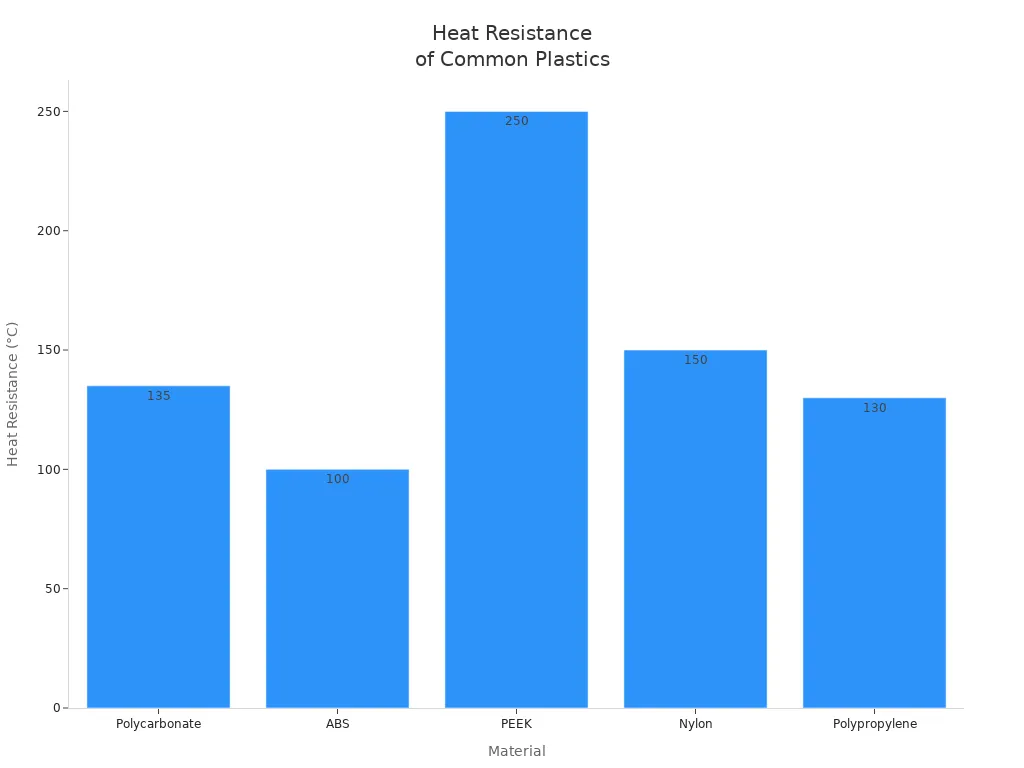
Polycarbonate can handle heat up to 135°C.
It works better than ABS and PVC in hot places.
PEEK has the highest heat resistance for tough jobs.
Polycarbonate works well in both cold and hot conditions.
Thickness
The thickness of your polycarbonate sheet changes how you bend it. Thin sheets, up to 4mm, are best for cold bending. Thicker sheets need heat to bend safely. The table below shows which method fits each thickness:
| Bending Method | Maximum Thickness |
|---|---|
| Cold Bending | Up to 4mm |
| Heat Bending | Thicker materials than 4mm |
If you use the right way for the thickness, you get smooth bends and avoid damage. Always match your tools and method to the sheet thickness when Bending Polycarbonate.
Bending Polycarbonate Methods
When you work with polycarbonate sheets, you can choose between cold bending and hot bending. Each method has its own advantages and best uses. You need to understand how each process works to get the best results and avoid damage.
Cold Bending
Cold bending lets you shape polycarbonate sheets without using heat. You press the sheet into a curve or angle. This method works best for thin sheets, usually up to 4 mm thick. You can use cold bending for simple shapes like u-channels or gentle curves.
You must follow some important rules to prevent cracks or stress fractures. Always keep the bend radius large enough. If you bend the sheet too tightly, you risk breaking it. Experts recommend that you do not cold form polycarbonate to a radius tighter than 100 times its thickness. For example, if your sheet is 2 mm thick, the minimum bend radius should be 200 mm. High stress levels, above 1500 psi, can cause chemical stress cracking. You can protect your sheet by using a chemical-resistant coating in tough environments. Early planning helps you design out stress before you start bending.
Minimum Bend Radius for U-Channel Bends
You need to pay close attention to the minimum bend radius for u-channel bends. This helps you avoid cracks and keeps your project strong.
The minimum bending radius for polycarbonate sheets is 200 times the thickness of the sheet.For a 2 mm thick sheet, use a minimum bending radius of 400 mm.
If you follow these guidelines, you can bend polycarbonate safely and keep your finished product strong.
| Sheet Thickness (mm) | Minimum Bend Radius (mm) |
|---|---|
| 2 | 400 |
| 3 | 600 |
| 4 | 800 |
Cold bending works well for signs, covers, and simple frames. You save time because you do not need special heating equipment.
Hot Bending
Hot bending uses heat to make polycarbonate sheets soft and flexible. You can use a heat gun, convection oven, or bending machine. This method works best for thick sheets and complex shapes. You heat the bend line until the sheet becomes easy to shape.
You must control the temperature carefully. Most polycarbonate sheets bend well between 350°F and 375°F. If you heat the sheet too much, it can warp or lose strength. If you do not heat it enough, it may crack when you try to bend it. Hot bending lets you make sharp angles and tight curves that cold bending cannot achieve.
Hot bending is perfect for large projects, custom shapes, and repeated production. You can use this method for machine guards, display cases, and architectural panels.
| Bending Method | Sheet Thickness | Temperature Needed | Best Use Cases |
|---|---|---|---|
| Cold Bending | Up to 4 mm | None | Simple bends, u-channels |
| Hot Bending | Over 4 mm | 350°F – 375°F | Complex shapes, thick sheets |
When you choose between cold and hot bending, think about your sheet thickness and the shape you need. If you follow best practices, you can avoid damage and get strong, clean bends every time. Bending Polycarbonate the right way helps you create durable and attractive products.
Bending Process

Preparation
Start by cleaning your polycarbonate sheet. Remove dust and grease with a soft cloth and mild soap. Dry the sheet completely. Measure and mark your bend line with a non-permanent marker. Use a straightedge for accuracy. Secure the sheet on a flat, stable surface. Wear safety glasses and gloves before you begin. Check your tools for damage or dirt. Sharp, clean tools help you avoid scratches and cracks.
Heating
Heat the polycarbonate along the bend line. Use a heat gun, strip heater, or convection oven, depending on your sheet thickness. Move the heat source slowly and evenly. This prevents hot spots and reduces the risk of bubbles or burns. For best results, follow these temperature guidelines:
| Thickness (mm) | Temperature (°F) | Duration (minutes) |
|---|---|---|
| 2 | 370 – 415 | N/A |
| N/A | 415 (high def) | N/A |
Keep the heat focused on the bend line. Do not overheat the sheet. Watch for the polycarbonate to become soft and flexible.
Shaping
Once the sheet feels flexible, bend it slowly along the marked line. Use a bending bench, mold, or your hands for simple curves. For precise bends, automatic bending equipment or single strip heaters work well. These tools help you keep the angle and shape consistent.
Heat Application: Use ovens or heaters for uniform bends.
Automatic Bending Equipment: Get precise angles and equal shapes.
Single Strip Heaters: Make quick, accurate bends without advanced machines.
Hold the sheet in place until it keeps its new shape.
Cooling
Let the bent polycarbonate cool at room temperature. Do not rush this step. Fast cooling can cause stress and cracks. Keep the sheet in its mold or jig until it feels firm. Once cool, check the bend for smoothness and strength.
Bending Polycarbonate with care at each step helps you get professional results every time.
Safety
Protective Equipment
You need to stay safe when bending polycarbonate. Safety gear protects you from heat and sharp edges. It also keeps you safe from flying pieces. Always wear safety glasses to protect your eyes. Gloves keep your hands safe from burns and cuts. Use a face shield if you work with thick sheets. You should wear one when using power tools. Closed-toe shoes protect your feet from falling pieces. A long-sleeve shirt helps stop burns from hot tools.
Wear a helmet or hard hat in busy shops. Ear protection is needed when machines are loud. Check your safety gear before every project. Replace anything that is broken or worn out.
Essential Safety Gear Checklist:
Safety glasses or goggles
Heat-resistant gloves
Face shield
Closed-toe shoes
Long-sleeve shirt
Ear protection (for loud tools)
Helmet or hard hat (for heavy-duty work)
Safe Tool Use
You must use tools carefully to avoid getting hurt. Always read the instructions for each tool. Keep your workspace neat and tidy. Check your tools for damage before you start. Use sharp blades and clean surfaces to stop cracks in polycarbonate.
People sometimes make mistakes when bending polycarbonate. You can avoid these problems by following good habits. The table below shows common safety mistakes and ways to prevent them:
| Common Safety Mistakes | Avoidance Strategies |
|---|---|
| Not providing adequate bend relief | Add the minimum bend relief to your design. |
| Overbending without consideration | Overbend a little to get the right angle. |
| Insufficient clearance for adjacent flanges | Make sure there is enough space to avoid collisions. |
| Ignoring material thickness effects | Watch for edge cracks and change for thickness and flange angle. |
Keep your hands away from hot surfaces. Turn off tools when you finish using them. Store sharp blades in a safe place. If you follow these steps, you can work safely and avoid getting hurt.
Equipment Care
Cleaning
You keep your tools in top shape by cleaning them after every use. Clean equipment helps you get better bends and keeps your workspace safe. Use gentle cleaners like dish soap or a mild detergent with anti-static properties. Warm water with a few drops of liquid detergent works well. Always use a soft cloth, such as microfiber, or a non-abrasive sponge. Avoid rough materials that can scratch your tools.
Dish soap (like Palmolive)
Mild detergent with anti-static effect (such as Vuplex)
Polycarbonate cleaner
Isopropyl alcohol for disinfection
Soft microfiber cloths or non-abrasive sponges
Rinse your tools right away with warm water. Wipe them dry with a clean cloth. If you need to disinfect, use isopropyl alcohol. For tough spots, you can use products like Dirtex®, Sol Bon Ami®, or even a small amount of ethanol. Always use light pressure to avoid damage.
Storage
Proper storage keeps your tools and equipment working longer. Store your heat guns, bending benches, and machines in a dry, dust-free area. Hang small tools on a pegboard or keep them in labeled drawers. Place safety gear in a clean, easy-to-reach spot. Cover large machines with a dust cover when not in use.
Keep tools dry to prevent rust.
Store sharp blades in protective cases.
Avoid stacking heavy items on top of delicate equipment.
You protect your investment by storing everything the right way.
Inspection
Regular inspection helps you catch problems early. Check your tools before and after each project. Look for cracks, dull blades, or loose parts. Test heat guns and ovens to make sure they reach the right temperature. Inspect safety gear for wear and tear.
Examine cords and plugs for damage.
Make sure moving parts work smoothly.
Replace worn-out gloves or goggles right away.
Choosing Tools
DIY vs. Professional
You need to decide if you want to use DIY tools or professional equipment. DIY tools work well for small projects and simple bends. You can use a heat gun or a basic bending bench at home. These tools cost less and are easy to use. You do not need special training to operate them. Professional equipment suits large projects and complex shapes. Bending machines and convection ovens give you precise results. You can make many pieces that look the same. Professional tools help you save time and reduce mistakes. If you want high accuracy, choose professional equipment.
Project Size
Project size affects your choice of tools. Large polycarbonate sheets weigh more, so you must think about safety. Handling big sheets can be hard without the right equipment. You need machines that hold the sheet flat and heat both sides evenly. The length of the sheet matters because polycarbonate expands when heated. If your project is complex, you may need advanced bending machines. Simple projects with small sheets let you use basic tools.
Large sheets need strong machines for safe handling.
Complex shapes require precise bending equipment.
Sheet length changes during heating, so plan your bends carefully.
Budget
Your budget guides your tool selection. DIY tools like heat guns and small benches cost less. Professional machines cost more but offer better results for big jobs. You need to consider extra features like double-sided heating and timers for accuracy. Machines that diffuse heat and hold sheets flat help you avoid mistakes.
| Machine Type | Price Range |
|---|---|
| Automatic Acrylic Channel Letter Hot Bending Machine | $4,950 – $6,950 |
| Plexiglass Acrylic Plastic Heat Bending Machine | $2,000 – $2,259 |
| High Productivity Plexiglass Bending Machine | $2,200 – $2,300 |
A cold bending press brake or bending machine can cost between $9,600 and $12,000. If you work on small projects, you can save money with basic tools. For large or repeated jobs, investing in professional equipment pays off over time.Picking the right tools and ways to bend polycarbonate helps you get strong and neat bends. Always use sharp tools so you do not scratch or break the sheet. Do not push the material too hard. Here are some important steps to follow:Heat the sheet slowly and evenly.Use a bending jig or strip heater for exact bends.Let the sheet rest after you bend it.
| Aspect | Recommendation |
|---|---|
| Machines Used | Heat-controlled bending machines |
| Temperature Control | Heat polycarbonate to 180–210°C for pliability |
| Cooling | Use controlled cooling to prevent warping |
Be careful, stay safe, and use good habits for every project.

